

Hip Pain
Some people feel pain deep in the groin. Others notice aching on the outside of the hip, pain getting out of the car, trouble sleeping on one side, or stiffness after sitting. Sometimes the hip is the problem. Other times, the back, pelvis, nerves, or movement patterns are shaping the experience.
Our goal is not simply to label the pain—it is to understand why your symptoms behave the way they do and what your body may be asking for.
Your Hip May Not Be the Whole Story
Hip pain is sometimes about the hip joint itself—but not always.
We frequently see people who were told they had “hip bursitis,” “arthritis,” or a “tight hip flexor,” only to discover that the pattern also involved the low back, nervous system, movement habits, or how the pelvis and ribs were coordinating.
That does not mean the hip pain is “all connected” in a vague way. It means the body often adapts, compensates, and changes movement when something becomes sensitive.
The pattern matters.
Common drivers
- hip mobility loss
- pelvic or gait control issues
- low back contribution
- training load that exceeds current tolerance
What makes it worse
Pushing through weight-bearing activities without addressing pelvic control, ignoring how the low back is compensating, or training harder while the nervous system is still protecting the joint.
What good care looks for
The hip joint, plus how pelvic stability, gait mechanics, low back function, and nervous system guarding are creating the load imbalance in the first place.
Where people usually start
If you think you could benefits from this approach these are the steps to take.
- Schedule the initial exam
- Receive a customized treatment plan
- Follow the plan and get back to living your life

Hip Pain FAQ’s
What causes hip pain?
Hip pain can come from arthritis, tendon irritation, bursitis, labral irritation, stiffness, nerve symptoms, old injuries, or movement changes involving the pelvis and low back.
Why does my hip hurt when I walk?
Pain walking may be related to tendon irritation, arthritis, joint sensitivity, muscle weakness, or movement changes that increase load through the hip.
Why does my hip hurt when I sleep on my side?
Pain lying on one side is common with irritation of the tissues around the outside of the hip, especially when pressure builds overnight.
Is it my hip or my back?
Sometimes it is hard to tell. Hip pain can feel like back pain, and back pain can feel like hip pain. Pain into the groin often points toward the hip, while burning, tingling, or symptoms traveling down the leg may suggest nerve involvement—but the full pattern matters.
What is hip bursitis?
“Hip bursitis” often describes pain on the outside of the hip, but newer research suggests the tendons around the hip are often involved too. Labels matter less than understanding what is driving the irritation.
Why does my hip feel stiff after sitting?
Stiffness after sitting may relate to joint irritation, mobility loss, arthritis, muscle guarding, or movement habits that limit hip motion over time.
Can arthritis cause hip pain?
Yes, but arthritis findings on imaging do not always predict pain levels. Some people with arthritis have little pain, while others are more sensitive.
Why does my hip hurt getting out of the car?
Pain getting in or out of the car commonly relates to compression or pinching in the front of the hip, stiffness, or sensitivity with rotational movement.
Can hip pain cause back pain?
Yes. The hip and low back often influence one another. Limited hip motion may increase stress elsewhere, while back problems sometimes refer pain into the hip.
When should I worry about hip pain?
Seek evaluation if pain follows trauma, causes inability to bear weight, sudden weakness, fever, unexplained swelling, or major loss of mobility.
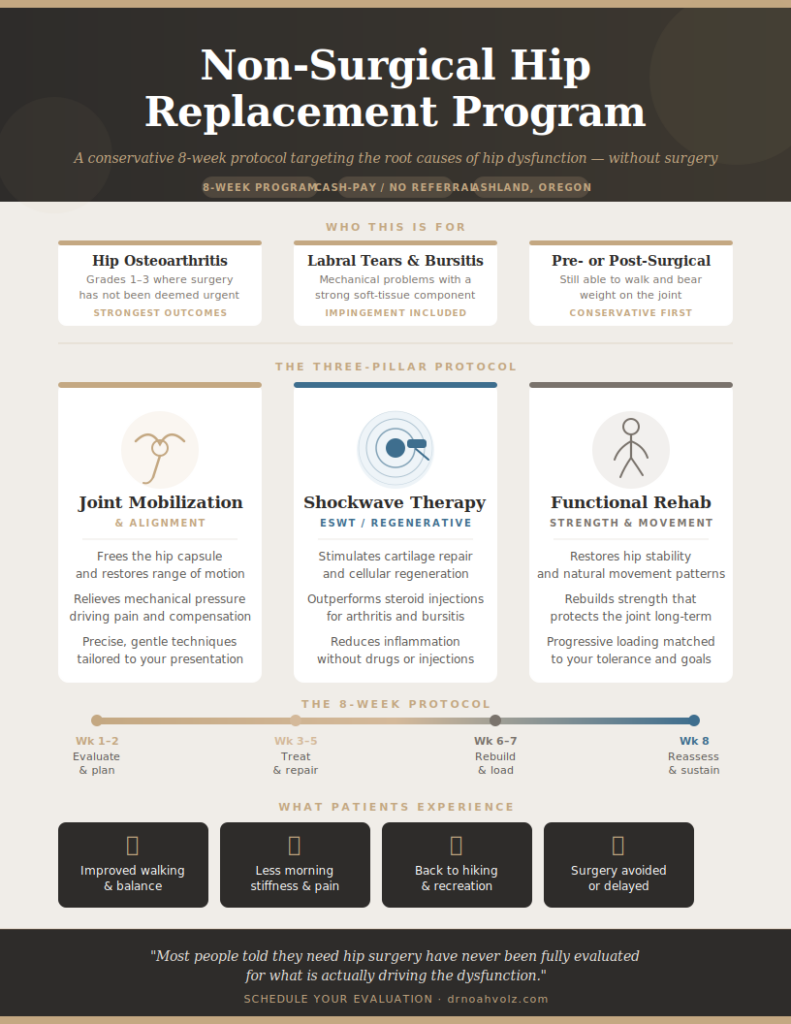
Learn more about the Non Surgical Hip Replacement Plan
Information on our personalized 8 week plan for chronic hip pain