
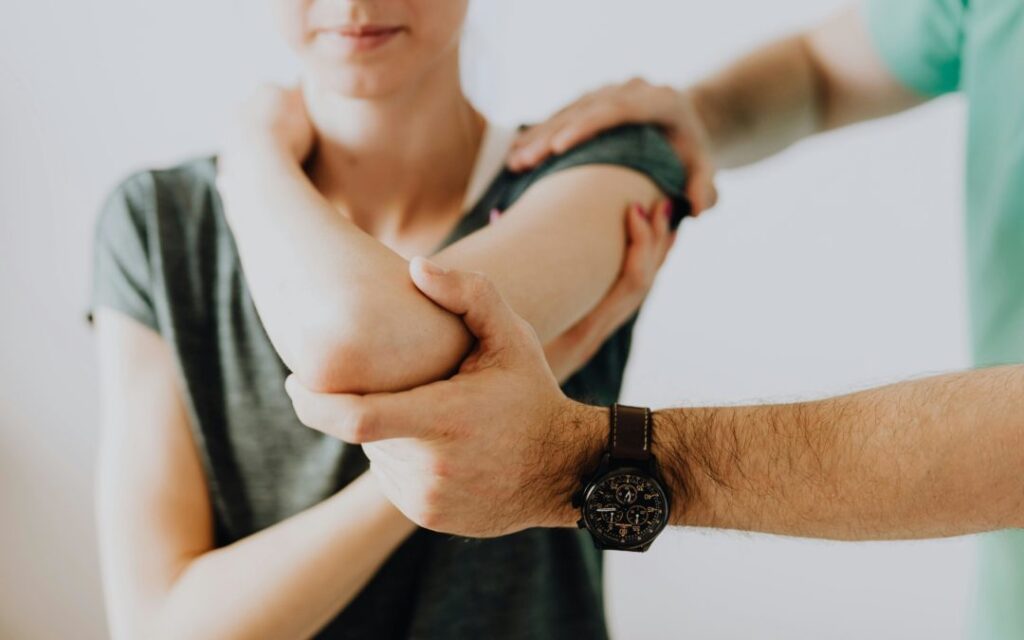
Arm pain care built around restoring function
Elbow and Hand Pain Treatment in Ashland, OR
Elbow and hand pain can make everyday tasks—from typing to lifting groceries—feel impossible. This page is a resource for understanding and managing upper extremity pain.
What You’re Actually Dealing With
The numbers: Tennis elbow (lateral epicondylitis) affects 1-3% of the population annually, with peak incidence between ages 35-50. Carpal tunnel syndrome affects 3-6% of adults, making it the most common entrapment neuropathy. These conditions aren’t just painful—they significantly impact work productivity and quality of life.
Why it’s not just “overuse”: Recent 2025 research reveals that tennis elbow isn’t simply an inflammatory condition—it’s a degenerative process involving failed tendon healing. Similarly, carpal tunnel often involves more than just median nerve compression at the wrist; it can be influenced by cervical spine dysfunction, thoracic outlet issues, and systemic factors like diabetes or thyroid disorders.
The neck connection: Studies show that up to 30% of patients with carpal tunnel symptoms have cervical radiculopathy contributing to their symptoms. This is why treating only the wrist often fails—if the nerve is irritated at the neck, wrist splints and local treatments provide incomplete relief.
DIY Strategies That Actually Work
1. The Tyler Twist (Tennis Elbow)
This evidence-based exercise uses a FlexBar or similar resistance bar to eccentrically load the wrist extensors:
- Hold the FlexBar with both hands, palms down
- The affected arm’s wrist should be extended (bent back)
- The unaffected arm twists the bar forward
- Slowly allow the affected wrist to flex (bend forward) against resistance
- Perform 3 sets of 15 repetitions, once daily
A landmark study showed 81% of patients achieved complete resolution of symptoms with this protocol.
Video tutorial: Dr. Tim Tyler: Tyler Twist Exercise (450K views) — The original demonstration by the physical therapist who developed the protocol.
2. Reverse Tyler Twist (Golfer’s Elbow)
For medial epicondylitis (golfer’s elbow), reverse the motion:
- Hold the FlexBar with palms up
- The affected arm’s wrist should be flexed (bent forward)
- The unaffected arm twists the bar backward
- Slowly allow the affected wrist to extend against resistance
- Perform 3 sets of 15 repetitions, once daily
3. Nerve Glides (Carpal Tunnel)
Median nerve mobilization can reduce symptoms and improve function:
- Extend your arm straight out with palm facing up
- Extend your wrist and fingers back (like “stop” gesture)
- Side-bend your head away from the extended arm
- Hold for 3-5 seconds, then release
- Repeat 10 times, 2-3 times daily
Important: Nerve glides should not increase symptoms. If they cause pain, numbness, or tingling that persists, stop and consult a professional.
Video tutorial: E3 Rehab: Carpal Tunnel Syndrome Exercises (680K views) — Comprehensive nerve glide and strengthening routine.
4. Wrist Extensor Stretching
For tennis elbow, stretching the wrist extensors is essential:
- Extend your arm straight with palm facing down
- Use your other hand to bend the wrist down (flexion)
- You should feel a stretch along the top of your forearm
- Hold for 30 seconds, repeat 3 times
- Do this 3-4 times daily
5. Self-Massage for Forearm Muscles
Use your thumb or a massage ball to work tight spots in the forearm muscles:
- For tennis elbow: Focus on the extensor muscles (top of forearm), especially near the lateral epicondyle
- For golfer’s elbow: Focus on the flexor muscles (bottom of forearm)
- Apply moderate pressure and make small circular motions
- Work for 2-3 minutes, 2-3 times daily
6. Ergonomic Adjustments
For computer users and those with repetitive hand tasks:
- Keyboard position: Keep wrists neutral (not bent up, down, or sideways). Consider a negative-tilt keyboard tray.
- Mouse position: Keep it close to your body. Consider an ergonomic mouse that keeps your wrist in a neutral position.
- Take breaks: Follow the 20-20-20 rule—every 20 minutes, look at something 20 feet away for 20 seconds, and stretch your hands/wrists.
- Phone use: Avoid prolonged texting with thumbs. Use voice-to-text or alternate fingers.
7. Night Splinting (Carpal Tunnel)
Wearing a wrist splint at night keeps the wrist in a neutral position, reducing pressure on the median nerve. Research shows this can significantly reduce symptoms, especially morning numbness and tingling.

What the Research Says (2024-2025)
Eccentric exercise is superior for tennis elbow: Multiple studies confirm that eccentric loading (lengthening the muscle under tension) produces better outcomes than concentric exercise for lateral epicondylitis. The Tyler Twist protocol has the strongest evidence base.
Conservative care works for carpal tunnel: A 2024 systematic review found that conservative treatments—including splinting, nerve glides, and activity modification—are effective for mild to moderate carpal tunnel syndrome. Surgery is typically reserved for severe cases or those that don’t respond to 6-12 months of conservative care.
The cervical spine connection: Research continues to support the “double crush” phenomenon—nerve irritation at one site (like the neck) makes the nerve more vulnerable to compression at another site (like the wrist). This explains why some carpal tunnel cases don’t respond to wrist-only treatment.
Shockwave therapy shows promise: Recent studies indicate that extracorporeal shockwave therapy can be effective for chronic tennis elbow that hasn’t responded to other treatments, with success rates comparable to surgery but without the risks.
Best External Resources We Found
Must-Read Articles
- PMC: Effectiveness of the Eccentric Exercise Therapy in Tennis Elbow — Systematic review of eccentric exercise protocols.
- NIH StatPearls: Lateral Epicondylitis — Comprehensive clinical overview of tennis elbow.
- PMC: Carpal Tunnel Syndrome: Diagnosis and Management (2024) — Current evidence-based guidelines.
- American Society for Surgery of the Hand: Carpal Tunnel Syndrome — Patient education from hand surgery specialists.
Top YouTube Resources
- Dr. Tim Tyler: Tyler Twist Exercise (450K views) — Original demonstration of the evidence-based protocol.
- E3 Rehab: Carpal Tunnel Syndrome Exercises (680K views) — Comprehensive nerve glide and strengthening routine.
- Bob & Brad: Tennis Elbow Exercises (1.2M views) — Famous PTs demonstrating multiple treatment approaches.
- Mayo Clinic: Carpal Tunnel Syndrome (890K views) — Medical institution explaining diagnosis and treatment.
When to Seek Professional Help
While many elbow and hand issues respond to self-care, some require professional evaluation:
Seek immediate care if:
- You experience sudden weakness in grip or hand function
- You have severe pain after trauma
- You notice muscle wasting in the hand (thenar eminence)
- You have signs of infection (redness, warmth, fever)
Schedule an evaluation if:
- Symptoms persist beyond 6-8 weeks despite self-care
- Pain interferes with work or daily activities
- You experience numbness or tingling that doesn’t resolve
- You’re considering surgery—conservative care should be exhausted first
My Approach: Integrated Elbow & Hand Care
Elbow and hand pain rarely exist in isolation. In my practice, I assess the entire upper extremity kinetic chain—from the cervical spine through the shoulder, elbow, wrist, and hand. Using the Neubie device, I can identify exactly where your nervous system is guarding and retrain those patterns.
For tennis elbow, treatment includes addressing cervical and thoracic spine dysfunction, gentle elbow mobilization, soft tissue work on the extensor muscles, and progressive eccentric loading. For carpal tunnel, I evaluate the cervical spine and thoracic outlet in addition to the wrist, because nerve compression often occurs at multiple sites.
My goal is to restore pain-free function while giving you the tools to prevent recurrence.